
What is an EPOS System? A Complete Guide for Irish Businesses



The age of the internet, of information, of data collection, has led to huge changes in the way commerce takes place. EPOS is a key part of that. New technology, now increasingly sophisticated and accessible, allows small and large businesses alike to benefit from greater flexibility, sales data, and security that EPOS provides.
Bank of Ireland's own data shows point-of-sale transactions rose 3% year-on-year in Q1 2026, with 124.2 million contactless payments processed in the same quarter, a sign of how firmly Irish consumers have moved toward card and contactless spending. For any retail or hospitality business, that shift makes a modern EPOS system less of a nice-to-have and more of a basic requirement. This type of investment is absolutely instrumental in fueling your company's growth, but there are a lot of factors to consider before making the final leap.
Let’s start with a basic EPOS definition, EPOS system meaning, and the benefits for business.
What is an EPOS till?
So what does EPOS stand for? EPOS stands for Electronic Point of Sale, also known as POS systems (more on that below), the modern till system used by shops, cafés, and restaurants, not to be confused with Ireland's Employment Permits Online System. EPOS systems are modernised tills that help manage and improve business operations in a wide range of areas, from data collection, accountancy, product and inventory management to sales processing.
EPOS vs POS: What's the difference?
If you've searched "what is EPOS" and seen "POS" used interchangeably in the results, you're not imagining things; they're two names for the same technology.
-
EPOS stands for Electronic Point of Sale, and it's the term most commonly used in Ireland and the UK.
-
POS stands for Point of Sale, and it's the term most commonly used in the US and internationally.
Both refer to the same category of system: the combined hardware and software that processes sales, tracks stock, and manages your business day-to-day. If you're comparing Irish and international suppliers, don't be thrown by the different labels; a "POS system" and an "EPOS system" are basically the same thing. Confusing, we know.
What does EPOS mean for business?
EPOS combines the basic functionality of a cash register with the greater potential of computer software and the growth and adaptability of a web-based system. What this leads to is a product that businesses can rely on for everything they need to run the business, plan for the future, and keep records of trade.
With such a strong foundation, businesses can then use an EPOS device to expand into different areas of commerce. For some businesses, this means connecting to a website or an app that provides online ordering services or opening more branches, which can be integrated into one system for multiple stores.
The flexibility of EPOS systems can be a huge advantage to growing businesses, as the system can grow alongside the business. To learn more about how EPOS can support a business, give our blog on EPOS software a read.
Gain all the advantages of an EPOS system with detailed, flexible, downloadable reports, and so much more:
- Manage and update products quickly with easy to use software
- Expand your business into multiple channels and integrate with a variety of online platforms
- Manage multiple locations and salespoints with multi-site management
- Keep queues short with streamlined, modifiable sales processes
- Choose a setup that suits you with software and hardware options
What is EPOS hardware?
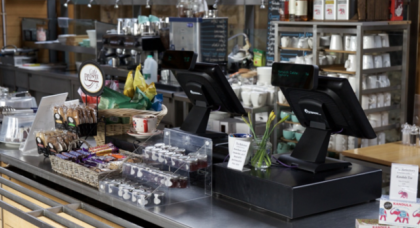
Depending on your business, your system is going to have different requirements to suit your needs. For both retail and hospitality, there are many additional hardware items businesses may find useful. But there are items that most businesses can expect to need as part of their system. For example, in addition to the main EPOS terminal (till), typical businesses might have a system composed of these items:
- Receipt printer- Small printing device using ink or thermal paper creates a customer record of the transaction.
- Barcode scanner- Electronic scanner that reads barcodes, allowing you to identify product items on the EPOS system.
- Card machine- A card payment processor used to electronically transfer funds via chip and pin, contactless or Apple/Android Pay.
- Cash drawer- A lockable metal drawer used to store cash.
What you need depends on your type of business. A busy café will typically need a fast card machine and receipt printer to keep queues moving, while a pub or restaurant will usually need a cash drawer and card machine at the till, plus a second receipt printer in the kitchen or at the bar for order tickets. A retail shop tends to rely more heavily on the barcode scanner for stock and pricing accuracy, alongside the till and card machine.
Card processing devices can be integrated with the till screen, sending transactions directly from the till to the credit card reader. This saves time, shortens queues, and gives staff the freedom to engage with the customers for longer periods of time.
EPOS hardware utilises modern technology to bring previously isolated devices into one coordinated, customised, service-providing system. While the above example applied to retail stores, the hospitality sector is no different.
With mobile payments, web-based printing from bar to kitchen, and online ordering integrated into your EPOS, sales across multiple channels can all be managed in one place. Working in such a coordinated way allows the EPOS system to create something far greater than the sum of its parts.
EPOS and Irish VAT compliance
Getting VAT right isn't optional, and it's one of the main reasons Irish businesses need an EPOS system rather than a basic cash register. Ireland currently applies three main VAT rates, and your EPOS needs to handle all of them correctly:
-
23% (standard rate): most goods and services, including alcohol and non-essential retail items
-
13.5% (reduced rate): hotel and guest accommodation, admission to cinemas, theatres, and museums, and certain building services
-
9% (second reduced rate): as of 1 July 2026, restaurant, café, and hot takeaway food (excluding alcohol, soft drinks, and bottled water) moved into this band, along with hairdressing services, gas and electricity, and e-books
This is a recent change worth calling out specifically: from 1 July 2026, the VAT rate on restaurant, catering, and hairdressing services in Ireland was permanently cut from 13.5% to 9%. Any hospitality business still charging the old 13.5% rate on food after that date is charging incorrectly, so this is a timely reminder to check your EPOS configuration.
Because a single hospitality business might sell items across two or three of these rates in one transaction, a meal at 9%, a bottle of wine at 23%, your EPOS system needs to apply the correct rate automatically at the point of sale, not leave it to staff to calculate. A good EPOS also generates VAT-compliant reports that make it far easier to file accurate returns with Revenue.
What is EPOS data?
Where traditional cash registers record sales and print receipts, EPOS systems record this transactional information and generate detailed sales reports in response to the data input. This affords owners and managers more insight into their business, allowing them to make actionable changes to increase revenue and cut costs.
EPOS reporting covers areas from employee productivity, stock figures, accounting and customer credit information.
A system’s software also retains detailed transaction data. Transaction data can be essential for handling returns and complaints, as managers can easily find out who served a customer, when this was done, and what was paid.
These reports help businesses run more efficiently and effectively. The essence of EPOS is about operating in real-time, modifying systems in response to the contemporary needs of businesses.
Most EPOS systems can be customised to help businesses run their operations, including loyalty schemes, staffing, accounting, stock levels management and marketing facilities. Many of these processes can be automated, much like the creation of EPOS information, so very little needs to be done to complete tasks like stock management. This saves users hours and allows businesses to focus on boosting sales and engaging with customers.
What are EPOS benefits?
The biggest EPOS advantages undoubtedly stem from how the software simplifies, streamlines, and connects multiple aspects of business operations. The advantages of modern computing mean that different companies can integrate their software and data can be transferred quickly and easily between forms.
This means, for instance, that customer loyalty programs can be managed and updated through an EPOS system run by the EPOS provider. Accountancy can be completed through programs like Sage or Xero with data automatically exported when the day's trading is finished.
Customers keep their loyalty programs and have fewer hoops to jump through to complete sales. The workload of the staff running the business is lowered, and management has a greater understanding and control over these processes.
In addition to speedy touchscreen terminals, the front till software can be modified to suit business needs. While retailers rely on barcodes for product numbers, hospitality (and bestselling retail products) can be coordinated for easy sales processing and then sent through to the integrated card machine for payment.
Managers control how and where products appear, with ordering and colour coding available. This can be done from anywhere in the world due to the use of cloud technology. The enormous amount of data generated and manipulated by the EPOS software is stored on the provider's servers and accessed via secure login information. If you're still not convinced as to why you need an EPOS, give our dedicated EPOS benefit blog a read.
How much does an EPOS system cost in Ireland?
While costs tend to vary depending on the provider and features you choose, as well as your business size, here's a rough guide:
-
Software: typically €50–€150 per month for a cloud-based EPOS subscription
-
Hardware: typically €800–€1,200 for a basic single-till setup (terminal, receipt printer, cash drawer, and card machine)
-
Bundled solutions: providers like Epos Now offer complete hardware-and-software packages — currently from €549 as a limited-time offer, down from a usual price of €899
With most providers, you can expect either an outright purchase or a monthly subscription/leasing model. Leasing keeps upfront costs lower, which can help newer or smaller businesses manage cash flow, while buying outright works out cheaper over several years for established businesses that don't expect to switch systems soon. Before you commit to a system, make sure to do your research and ask questions. Your EPOS system is the backbone of your business, and getting it right from the start will save you time, money, and headaches down the line. To learn more about EPOS pricing, give our in-depth cost breakdown a read.
A solution to business problems
Now that you know what EPOS is, it's time to look for an Irish provider. Epos Now have been providing the very best EPOS technology to businesses for over a decade, allowing businesses to benefit from a system that expands with them. The Epos Now solution is used by 64,000 business locations across 74 countries, with an award-winning platform and an overall Trustpilot score of 4.5/5. In Ireland, Epos Now also provides dedicated local support, with an Irish team ready to help 24/7.
Here's what you can expect with Epos Now:
- A top-of-the-range, cloud-based solution updated each month to ensure you never fall behind
- Easy-to-use transaction software for a streamlined sales process for payment processing
- Hundreds of flexible, detailed, downloadable reports to ensure you’re fully informed and able to make the best business decisions
- The very latest app options to optimise your potential in marketing, accounting, product and inventory management, eCommerce and more
For the very best hardware and software offers, explore our full range of EPOS systems, call +353 1 963 8949, or submit your details below to have a conversation with our expert team.
Get Started with a multi-award-winning EPOS system
Submit your information to speak with an expert and find out more about how Epos Now could benefit your business.
Frequently Asked Questions
- What does EPOS stand for?
-
EPOS stands for Electronic Point of Sale, a modernised till system that combines sales processing with software for inventory, reporting, and business management.
- What is the difference between EPOS and POS?
-
Nothing, they're the same technology! "EPOS" is the term more commonly used in Ireland and the UK, while "POS" is more common in the US and internationally.
- Do I need an EPOS system for my business in Ireland?
-
It's not a legal requirement, and the answer does depend in part on the type and size of your business. But for most Irish retail and hospitality businesses, an EPOS system pays for itself through faster service, more accurate stock management, and easier VAT reporting than a manual till can offer.
- Does Epos Now work with Irish VAT rates?
-
Yes. Epos Now allows you to configure multiple VAT rates within the system, so the correct rate is applied automatically at the point of sale, including Ireland's current 23%, 13.5%, and 9% rates, with the 9% rate now covering restaurant and catering services as of 1 July 2026.
- Can I still use my EPOS if my internet goes down?
-
Most modern cloud-based EPOS systems, including Epos Now, include an offline mode that lets you keep taking sales during an outage, syncing the data automatically once your connection is restored.