What is a Sole Trader? The Complete Irish Guide for 2026


If you've ever researched going into business for yourself and becoming self-employed, you may have come across the term "sole trader." You might ask yourself what does this mean and how can it affect me?
In short, a sole trader is a self-employed person who is the sole owner of their business. As a term, it can be used interchangeably with sole proprietorship and generally refers to the structure of a business. If you choose to register as a sole trader, you and your business become one legal entity in the eyes of the law, and you're entitled to all your profits after tax.
Thanks to the relative ease with which one can become a sole trader, it has become a very popular option for self-employed people. Sole trading is one of the most common ways to start a business in Ireland, and if you're planning to open a small business it might be the right option for you.
What is a sole trader business?
A sole trader, also known as a sole proprietor or sole proprietorship, is a straightforward business structure where one individual operates and owns the entire business. It's one of the simplest ways to start a business because it doesn't require incorporation with the Companies Registration Office (CRO). In this setup, the sole trader has complete control over how the business operates and retains full autonomy in developing the business's identity and brand.
Usually, the sole trader is the sole worker in the business they've established. However, they can hire employees, in which case they need to register as an employer with Revenue and operate PAYE for managing payroll and taxes.
But before we go any further, let's look at the advantages and disadvantages of being a sole trader.
Advantages of a sole trader
As a small business owner, these are the advantages of being a sole trader:
For many, the freedom to work for yourself is the biggest benefit. Sole traders have complete control of their company. This means they're free to run it exactly how they want and make decisions as they see fit.
Depending on the industry, sole traders have little to no start-up costs. This, combined with the fact that there are very few annual accounting costs, means you'll be able to keep a much firmer grip on your overheads. This financial freedom extends to your profits, where you alone get to keep everything after tax.
Sole trader advantages extend as far as financial privacy, too. Unlike a limited company, whose accounts are publicly viewable on the CRO's website, sole traders are able to keep their finances strictly private. No member of the public is able to see a self-employed person's finances unless they choose to share them themselves.
Drawbacks of sole trading
While there are undeniable advantages to becoming a sole trader, there are several downsides. As long as your business keeps running smoothly, you should be able to avoid any of these adverse effects.
Unlimited liability refers to the fact that as a sole trader, you are personally liable for any and all of your business's debts and losses. For sole traders, there's no distinction between personal and business assets. If worse comes to worst and you suffer a big financial hit, creditors could come for assets such as your house, car, or anything else in your name.
Due to unlimited liability, some sole traders may have difficulty accessing finance. The private nature of your finances and the inherent risk of being self-employed means that lenders may be reluctant to offer as much as they would to a limited company. In turn, this can contribute to credibility issues, where your business is perceived as less established than a limited company. Some traders try to get over this problem by emulating the practices of successful businesses.
Being legally one and the same as your business can sometimes lead to complications when you try to sell it or transfer ownership to someone else when you retire. The process of separating personal and business assets means that some people choose to transfer their business to a limited company. As a limited company is owned by its shareholders, the personal and business assets of the owner are separate, making the transfer of ownership much easier.
Sole trader vs Limited company: what's the right choice for you?
Examples of sole traders
Lots of small shops and businesses are set up as sole proprietorships. Here are some common examples:
- Tradespeople: These are folks like builders, gardeners, landscapers, carpenters, and handymen.
- Freelancers: People who work independently in digital and creative fields (freelancers) often operate as sole traders. This includes jobs like graphic designers, web developers, writers, marketers, and social media experts.
- Gig economy workers: These are the ones who work flexible gigs, sometimes alongside another job. Think taxi drivers, couriers, delivery folks, and tutors.
How to set up as a sole trader in Ireland
Now that you've got a good understanding of what a sole trader is, let's talk about setting up as a sole trader. Here are some simple steps:
Choose a business name
As the sole proprietor of your business, it's up to you to come up with a suitable name for your company. Choosing a business name is an important step in legitimising yourself as a sole trader, so make sure to do it properly.
Your business name can be almost anything you want. Some sole traders choose to keep it simple and use their own name, some go for something professional-sounding, and some choose a catchy phrase. Whatever name you choose, make sure it's a good representation of who you are as a self-employed person and what your business does.
If you trade under a name other than your own, you must register that business name with the Companies Registration Office (CRO). There are a few guidelines to follow:
- Names that are rude or offensive will not be accepted.
- Sole trader business names can't include words like "Limited," "Ltd," "Teoranta," "Teo," or other terms that could give the impression your business is incorporated.
- Names can't use registered trademarks — this opens you up to legal action from the trademark owner. You can check registered trademarks on the Irish Patents Office website.
If you're unsure whether your name would be in breach of any of these guidelines, it's safer to err on the side of caution and choose a different name.
Register for self assessment
To operate as a sole trader in Ireland, you need to register as self-employed with Revenue, typically by completing a TR1 form or registering through Revenue's Online Service (ROS). You'll need to do this if you're starting to trade or earn self-employed income.
Registering promptly means you can access the Pay and File system properly and avoid penalties for late registration.
Becoming a VAT-register sole trader
Depending on your business and how much you earn, you might need to register for VAT. As of 2026, you generally need to register if:
- Your turnover from supplying services exceeds, or is likely to exceed, €42,500 in any continuous 12-month period.
- Your turnover from supplying goods exceeds, or is likely to exceed, €85,000 in any continuous 12-month period.
NOTE: Even if your turnover is under these thresholds, you can choose to register for VAT voluntarily. This might be beneficial if you want to reclaim VAT on business expenses, especially if your clients are VAT-registered businesses that can reclaim the VAT you charge.
If everything you sell is VAT-exempt, registration isn't required, but you won't be able to reclaim VAT on your business expenses.
Once registered, you must charge VAT on your invoices, file VAT3 returns (typically bi-monthly) through ROS, and remit the VAT collected to Revenue.
Sort out your PRSI
As a sole trader, you'll pay Class S PRSI on your profits — this is your equivalent of social insurance, contributing towards your State Pension and certain benefits. For 2026, Class S PRSI is charged at just over 4% of reckonable income, subject to a minimum annual contribution of €650 where reckonable income is at least €5,000.
Your PRSI liability is calculated as part of your annual tax return, alongside your income tax and USC.
Set up a business bank account
It's smart to keep your personal and business finances separate. Opening a business bank account makes it easier to track your income and expenses. Plus, it shows you're serious about your business.
Most Irish banks offer business accounts with features like accounting software integration and, in some cases, discounts on business services. To get started, bring your ID, proof of address, and evidence of your business registration.
Everything in one package
Our EPOS system enables you to adapt, gain new customers, increase profit and remain future-proof.
- Set up, onboard and train staff in minutes
- Online, delivery, collection and multi-channel ready
- Access your business insights through any device, on-the-go
- Real-time reporting on staff, customers, sales, margin and stock
- Use standalone, or connect to hundreds of apps including payment systems, accounting software and much more
Working as a sole trader and tax responsibilities in Ireland
Sole traders don't pay corporation tax. Instead, they pay income tax, USC, and PRSI through the Pay and File system.
Pay income tax
As a sole trader, you pay income tax on your profits after deducting allowable business expenses. Ireland uses the same 20% standard rate / 40% higher rate income tax bands that apply to PAYE employees, with the standard rate band and personal tax credits set out annually by Revenue. As a self-employed person, you claim the Earned Income Credit in place of the PAYE employee credit.
Every year, you need to tell Revenue how much you've earned and what you've spent to work out how much tax you owe.
Universal Social Charge (USC)
USC is a separate charge on your gross income, calculated on a sliding scale across several bands (broadly 0.5%, 2%, 3%, and 8% as income rises). If your total income for the year is €13,000 or below, you don't pay USC at all — but once you go over that threshold, USC applies to your full income, not just the excess.
Self-employed people with non-PAYE income above €100,000 pay an additional 3% USC surcharge on the amount over that threshold, bringing the effective rate on that portion to 11%.
PRSI contributions
You'll also pay Class S PRSI, currently just over 4% of your profits, subject to the €650 minimum annual contribution. This goes towards your State Pension entitlement and certain other benefits.
Pay and File (Form 11)
This is where you lay it all out for Revenue. Self-employed people file an annual Form 11 return, generally due by mid-November if filing and paying through ROS. It's how you report your income, claim any tax deductions, and make sure you're paying the right amount of income tax, USC, and PRSI. You'll also typically need to pay preliminary tax for the current year at the same time as settling your previous year's balance, so it's important to budget for both. Getting this done on time is essential to avoid interest and penalties.
Business insurance
To keep yourself covered, consider getting business insurance. It can protect you if something goes wrong, such as a client making a claim against you or an accident at work. It's worth checking out different types of cover depending on what your business does.
Sole trader expenses
Claiming allowable expenses reduces your taxable profit, so it's worth knowing what you can deduct. Revenue generally allows expenses that are "wholly and exclusively" for the purposes of your trade, including:
- Office costs. Stationery, phone bills, and broadband used for business can all be claimed, even if you work from home and only use them partly for business.
- Travel and mileage. Business journeys, whether by car or public transport, are deductible (ordinary commuting between home and a fixed base generally isn't).
- Marketing and advertising. Website costs, social media ads, and printed materials all count.
- Professional subscriptions and training. Trade body memberships and courses that maintain or improve your existing skills are allowable.
- Equipment and tools. Anything needed to do the job, from laptops to trade tools, can usually be claimed, sometimes through capital allowances rather than as a straight deduction.
- Stock and materials. Goods bought to sell or use in your work are a straightforward deductible cost.
- Accountancy fees. Fees for bookkeeping, tax returns, or general business advice are allowable too.
For working from home, Revenue allows a portion of certain household costs (heat, light, broadband) based on business use — check current guidance on revenue.ie for exact rates and calculation methods before claiming.
Make being a sole trader easier
Becoming a sole trader is a decision that shouldn’t be taken lightly. If you do decide to go down the self-employed route, it’s important to make sure you have the tools you need to run your business the way you want to.
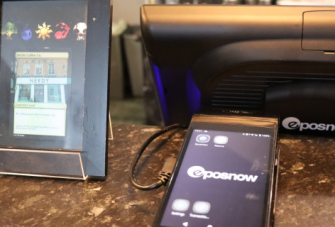
Running a business on your own means every tool needs to earn its place. Epos Now's cloud-based POS system gives sole traders a complete, real-time view of their sales, stock, and finances in one place, without the overhead of a full accounts team. Using an innovative cloud-based system, you’ll be able to control all the vital aspects of your business from one easy-to-use point of sale system.
Our systems can integrate with thousands of popular apps to make the process even simpler, such as key accounting integrations like Xero and Quickbooks.
Frequently asked questions
- What’s the difference between self-employed and sole trader?
-
Being self-employed means working for yourself, which is a big umbrella term. When you're a sole trader, though, it's a specific kind of self-employment where you're the only boss of your business. That means you're the one responsible for everything it does.
- Do sole traders need to register with the CRO?
-
Only if you trade under a business name other than your own — in that case, you register the name with the Companies Registration Office. For tax purposes, you register as self-employed with Revenue rather than incorporating a company. This also means your business finances stay private, unlike a limited company's accounts, which are publicly viewable via the CRO.
- How much tax do you pay as a sole trader in Ireland?
-
As a sole trader, you pay income tax on your profits at the standard 20% and higher 40% rates, plus USC on your gross income and Class S PRSI (subject to a €650 minimum). Keep good records of your income and expenses so you can report the right figures to Revenue each year.
- Can a sole trader have employees?
-
Absolutely. If you hire people to work for you, you'll need to register as an employer with Revenue and operate PAYE for their pay and tax. It's a bit more admin, but it's doable if you're ready to expand your business.
- When should I switch from sole trader to limited company?
-
There's no fixed rule, but it's often worth considering once profits are consistently in the region of €80,000–€120,000, as Ireland's 12.5% corporation tax rate on retained profits can start to outweigh the extra administrative burden. Wanting limited liability, investment, or added credibility can also be good reasons to switch earlier.
- Do I need an accountant as a sole trader?
-
It's not a legal requirement, but many sole traders find one valuable, especially as income or expenses grow. An accountant can help you claim the right expenses, stay compliant with Revenue's filing deadlines, and avoid costly mistakes on your Form 11.
- What are the current VAT thresholds for sole traders in Ireland?
-
As of 2026, you must register for VAT once your turnover exceeds €42,500 for services or €85,000 for goods in any 12-month period. You can also register voluntarily below these thresholds if it suits your business.