Bakery Interior Design: A Complete Guide to Layout, Branding & Customer Experience



Bakery interior design has never mattered more. In 2026, customers expect more from a bakery than just bread; they're looking for an experience. The statistics back it up: a well-designed bakery increases sales by 10–15% and customer dwell time by 30%, turning a one-time visitor into a regular.
But great bakery design goes beyond just the basics of picking paint and hanging some shelves. Today's most successful bakeries think about sustainability, operational flow, customer experience, and brand identity, all at the same time. Whether you're fitting out a new space or refreshing an existing one, this guide covers everything you need to design a bakery that brings people in.
How to approach interior design in a busy bakery environment
When designing interior space for a busy bakery, it’s important to consider how the design will impact both customers and employees. The interior design should be inviting and comfortable for customers while also providing an efficient workspace for staff.
The design world is filled with creative solutions, so approaching your bakery with a positive and organised mindset can help set you up for success. To start, think about what you need to include and the effect you want to create. Lists and mind maps can help you outline your needs, target themes, branding, and effects.
For example, you will need to include:
- A display case for your baked goods
- A point of sale and checkout counter
- Shelving units for storage
- Fridges and freezers
- Food preparation counters
- Customer seating areas
- Decorative features, plants, and displays
- A place for waste
TIP: Designing your bakery with a sense of your brand identity drives you towards a bakery that reflects who you are and improves the customer experience whenever someone enters your shop.
Latest Bakery Design Trends (2025–2026)
Bakery design moves fast. What felt fresh three years ago can date a space quickly, and customers, whether they realise it or not, notice. But don't be afraid to get creative and do something completely different, so here are a few popular ideas that you can use as inspiration.
Open kitchen layouts: The era of the hidden kitchen is over. Customers in 2025–2026 want to see where their food comes from, and the bakeries that show them are winning on trust and theatre simultaneously.
Natural materials and warm textures: Reclaimed wood, stone, and bare lime plaster aren't just a passing aesthetic; many bakeries are embracing the movement towards natural and soothing pared-back interiors.
Designed-for-sharing moments: The bakeries filling Instagram feeds in 2026 aren't just pretty by accident: the photo opportunity is all part of the plan. One in three consumers made a food or drink purchase directly through a social platform in 2024, which means a well-placed feature wall or striking display case is now a marketing channel in its own right.
Sustainability as a design: In 2026, sustainability is quickly becoming a non-negotiable, and many bakeries are embracing sustainability as the central theme of their interior design. Think reclaimed wood, thrifted furniture, energy-efficient lighting, and compostable packaging.
Outdoor seating: A few well-styled tables outside can dramatically increase footfall, dwell time, and street presence and is one of the easiest ways to extend the customer experience beyond four walls.
Choosing colours and themes
When it comes to creating a beautiful interior for your bakery, one of the key considerations is choosing colours and themes. The right colour palette can have a huge impact on the atmosphere in your shop, so it’s important to choose carefully. Your colours will need to suit the wider themes and the overall atmosphere you want to create, via your choice of furniture, lights, decorations, and overall use of space and branding.
There are no set rules on the number of colours to use in your bakery - generally, most businesses like to stick to two or three colours in various shades to make a cohesive feeling. But plenty of businesses balance multiple colours together in harmony to create fun or memorable locations for customers to share photos on their social media (great for free promotions).
When deciding on a concept for your bakery, consider how you want customers to feel when they enter your space. Do you want to evoke a feeling of traditionalism with classic furniture pieces and decorations? Or perhaps you’re more interested in creating a modern feel with sleek lines and modern art pieces? Whichever you choose, make sure it reflects the identity of your shop.
How bakery layout impacts sales & efficiency
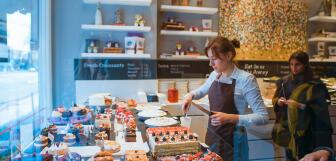
A well-designed bakery layout does more than look good: it actively drives revenue. Research suggests a thoughtful layout can increase sales by 10–15% and customer dwell time by up to 30%, simply by guiding customers through the space more intentionally.
The most effective bakeries follow a logical flow: entry → display → counter → payment → exit. This path isn't accidental. Positioning your display case immediately after the entrance means every customer passes your products before they reach the till, creating natural opportunities for impulse purchases. Set up your queue areas alongside high-margin items, such as individually packaged pastries, seasonal specials, and grab-and-go drinks.
Figuring out seating is also strategic and requires balance. Too little and you lose dwell time; too much and you compromise the floor space your staff need to operate efficiently. A useful benchmark is allocating roughly 60% of customer-facing space to flow and display, with seating filling the remainder.
Layout quick wins
- Place your display case at the entrance — not the counter
- Run high-margin items alongside queue areas
- Allocate ~60% of customer-facing space to flow and display
- Allow a minimum of 25" behind each chair
- Use wall-mounted or counter-height seating to preserve floor space
- Position your POS at the end of the customer journey
- Keep a clear path: entry → display → counter → payment → exit
Accessibility & inclusivity
Accessibility and inclusivity aren't just good practice; they are tenets of good business. Designing with inclusivity in mind widens your customer base and signals that your space is genuinely welcoming to everyone. Here's how you can ensure your bakery is accessible from the moment customers walk through the door.
The key areas to address are straightforward. Ensure at least one or two tables are wheelchair accessible, with adequate spacing between all seating to allow easy movement through the space. If your bakery has a display counter, consider incorporating a lower section so products are visible to customers in wheelchairs or of shorter stature. Clear, unobstructed pathways throughout the shop are essential: avoid displays or furniture that jut into natural walking routes.
Prioritising inclusivity from the start is a far cheaper method than retrofitting later, and the reputational benefit of being known as an inclusive, thoughtful space is hard to put a price on.
Branding & design
Branding & design
Your interior design is an extension of your brand: every material, colour, and fixture sends a signal about who you are and who you're for. The most memorable bakeries have a clear point of view that runs through everything, from the typeface on the menu board to the finish on the countertop. Before making any design decisions, get clear on how you want customers to feel when they walk in, and let that guide every choice.
In practice, that means applying your brand colour to key surfaces and fixtures, not just your logo. Your logo should appear consistently across the display counter, storefront, and packaging, and every design detail should be considered with social media in mind: a coherent interior is one that's recognisable in a single photo. If your bakery has a tagline or mission, find a natural place for it in the space, whether that's a wall, a chalkboard, or a printed card on each table.
Branding checklist
- Apply your brand colour to key surfaces, not just signage
- Reward repeat customers with a loyalty programme that ties into your brand identity.
- Place your logo consistently across the counter, storefront, and packaging
- Align staff uniforms with your brand colours and overall aesthetic
- Make sure every design detail is photo-worthy — coherent branding photographs well
- Integrate your tagline or mission into the space through signage or decor
The eco-friendly baker
Sustainability should be visible, not just stated. Use reclaimed wood, stone, and clay to create a warm, natural atmosphere, and bring in plant life where you can. Back it up with the details customers notice — upcycled furniture, recycled packaging, sustainably sourced ingredients. When the values are readable in the materials themselves, no sign is needed.
The artisan baker
An artisan identity is built on craft and simplicity. Raw plaster walls, reclaimed wood shelving, and minimal signage communicate quality without shouting about it. Keep the palette neutral — off-whites, warm greys, natural timber tones — and let the products do the talking. Kraft paper packaging, hand-written chalk menus, and open shelving that puts the baking process on display all reinforce the same message: this is a place that takes its bread seriously.
Display case design: the heart of bakery layout
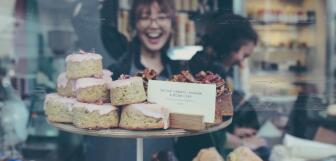
The display case is where browsers become buyers, with up to 60% of purchase decisions being influenced by visual presentation alone. Done well, it's less furniture, more storytelling.
The basics matter: double-tiered cases with clear labelling give every product its moment without crowding, while curved glass fronts feel more inviting than the traditional rectangular cabinet. Lighting temperature makes a quiet but significant difference too — 2700K LED strikes the right warmth, making pastries glow rather than glare.
Beyond the hardware, it's about organisation. Grouping by category — pastries, breads, cakes — helps customers navigate without feeling overwhelmed, and rotating seasonal displays gives regulars a reason to keep coming back.
Lighting
Lighting is one of the most underestimated elements of bakery design: get it right and your products look irresistible.
Match light levels to each area: display cases need 500+ lux to make colours and textures pop, while seating areas should sit around 200–300 lux to keep customers comfortable and relaxed. For colour temperature, 2700K warm white is the sweet spot for most bakeries, making pastries glow, and the space feel inviting. If your aesthetic leans more contemporary, 4000K gives a cleaner, neutral finish.
Spotlights on hero products create natural focal points, dimmable fittings let you shift the mood throughout the day, and pendant lights or Edison bulbs add warmth that photographs well.
Budget guidance for bakery interior design
Interior design is one of the highest upfront costs of opening or refreshing a bakery, but also one of the most impactful. Getting the budget right from the start avoids costly retrofits later and ensures your space is working hard from day one.
Costs typically fall into three tiers:
- Cosmetic refresh (paint, lighting, new signage): £5,000–£15,000 — ideal for bakeries that need a visual update without changing the layout.
- Partial renovation (new display case, seating, general refresh): £15,000–£40,000 — suitable for improving customer-facing areas without a full strip-out.
- Full design overhaul: £40,000–£100,000+ for new openings or significant rebrands where everything is being reconsidered.
Most bakeries see their design investment pay for itself within 18–24 months through increased footfall and higher average spend. If budget is tight, phase your renovations, but start with the display counter and lighting, which have the most direct impact on sales, and tackle seating and branding elements later.
Complete your look with an Epos Now POS till system
Sell your sweet treats at speed on our bakery POS system, or if you're running a café alongside your bakery, our café POS has you covered too. The Epos Now till uses a simple design to provide all the tools bakeries need on software that you can train your team to use in as little as fifteen minutes.
Epos Now users can:
- Create bespoke transaction setups on secure, speedy software to shave time off the sales process.
- Choose from dozens of apps and integrable partner programs to run accounting, marketing, and other back-of-house functions in a way that suits you.
- Benefit from detailed reporting to adapt your pricing strategy, manage inventory, staff, and more.
- Manage kitchen orders efficiently with our kitchen display system
- Stay on top of trade even when off-site, with cloud-based access to real-time sales and inventory data.
Get in touch with our expert team by submitting your details below, and join over 55,000 businesses using Epos Now technology.
Speak with one of our experts and learn more about Epos Now's top-selling technology
- How often should I refresh my bakery design?
-
While there's no timeframe set in stone, it's reasonable to budget for a refresh every five to seven years, although small seasonal updates to displays, signage, and props can be done every few months at minimal cost. The clearest sign it's time for a bigger refresh is when the space no longer reflects your brand or when footfall starts to dip without an obvious reason.
- What colours work best for a bakery interior?
-
While you can make any colour way work in your bakery, warm, neutral tones such as off-whites, creams, soft terracottas, and natural wood finishes work well in most bakeries because they feel inviting. Earth tones and Morandi colours (muted, dusty shades) are particularly on-trend in 2026 for bakeries going for an artisan or sustainable feel. Bold accent colours can work well for branding purposes, but stick to one or two to keep the space coherent.
- How do I optimise customer flow in a small bakery?
-
The key is a clear, logical path from entrance to exit: entry → display → counter → payment → exit. Position your display case immediately after the entrance so every customer passes your products before reaching the till, and keep queue areas narrow and alongside high-margin items.